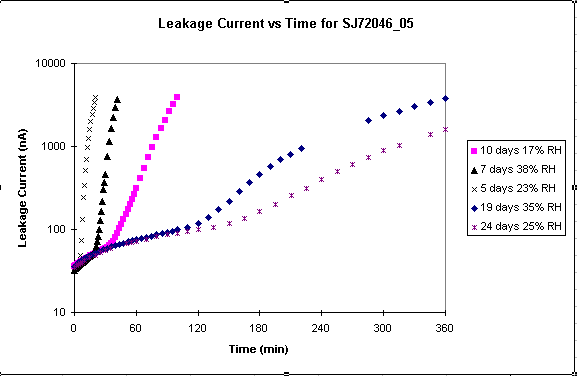
During Gerrit's visit to UIC, we found that wafers which had guard ring breakdown when tested at MIT now did not show the breakdown. It was hypothesized that this change was due to the wafers having been stored in dessicators at UIC which then dried out the sensors. To this test, we "hydrated" a wafer (Octagon SJ72046_05) by placing a damp paper towel underneath the holder inside of the gelpack and leaving it overnight. The wafer was tested the next day and showed a guard ring current of 170 uA at 50 V bias, i.e. it now broke down. The cleanroom was at 30% relative humidity. The wafer was left outside overnight in the lab at about 35% RH. The next day it showed 46 uA at 50 V bias with the cleanroom at 30% RH. The wafer was then stored in our dessicator at 20% RH. After storage for five days, it was tested again. At 50 V bias, the leakage current went from 33.9 nA to 3.91 uA in 20 minutes. The cleanroom humidity was at 23%. After storage for seven days at 20% RH, the leakage current went from 32.2 nA to 3.72 uA in 42 minutes. The cleanroom humidity was 38%. After storage for ten days at 20% RH, the leakage current went from 35.4 nA to 3.91 uA in 100 minutes. The cleanroom humidity was at 17%. After storage for 19 days at 20% RH, the leakage current went from 36.1 nA to 3.79 uA in 360 minutes. The cleanroom humidity was at 35%. After storage for 24 days at 20% RH, the leakage current went from 35.2 nA to 1.60 uA in 360 minutes. The cleanroom humidity was at 25%. These results are summarized in the following plots.
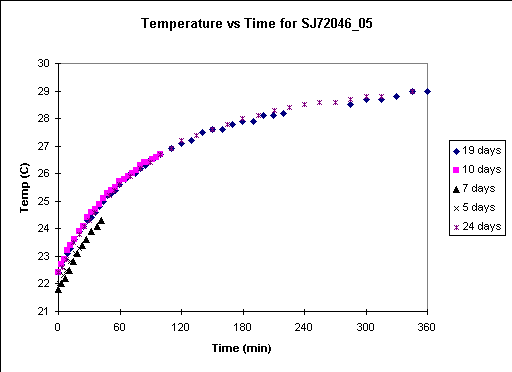
This plot shows the temperature in the prober enclosure
Three other octagon wafers (SJ72046_01, 02, 03) have been stored in our dessicator at 20% RH since the collaboration meeting in October. These were tested at 50 V bias for about six hours (except SJ72046_01) and the leakage current was monitored. With the cleanroom at 20% RH, the leakage current for SJ72046_02 went from 49 nA to 120.4 nA in about six hours. With the cleanroom at 23% RH, SJ72046_03 went from 42.2 nA to 109.7 nA in five hours. The wafer SJ72046_01 was tested under 50 V bias for about 70 hours (except for a five minute break to turn off our probe station). The leakage current went from 74.1 nA to 369 nA with the cleanroom humidity starting at 33% and dropping to 19% at the end. Again these results are summarized in the following plots.
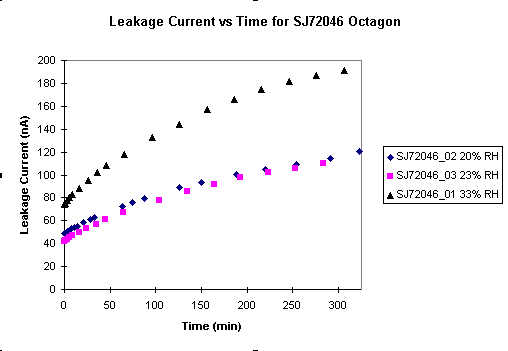
for SJ72046_01 the point at 70 hours is not plotted so as to show all three curves on the same scale
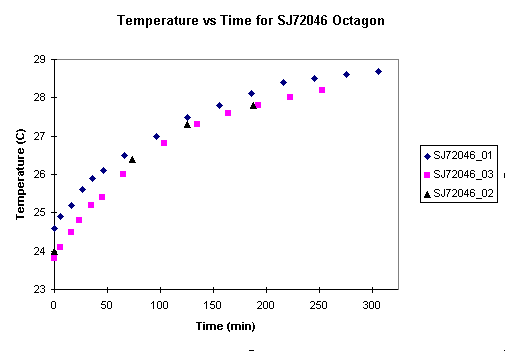
For the above wafers (the ones which have been stored at 20% or less RH for 2 months), a continual increase in the leakage current is seen. A measurement was performed to see how much of this is a temperature effect. The results are summarized in the graph below.
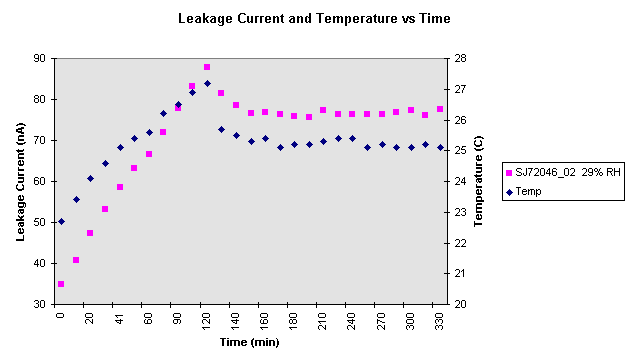
As this graph clearly shows, the rise in the leakage current is temperature dependent.