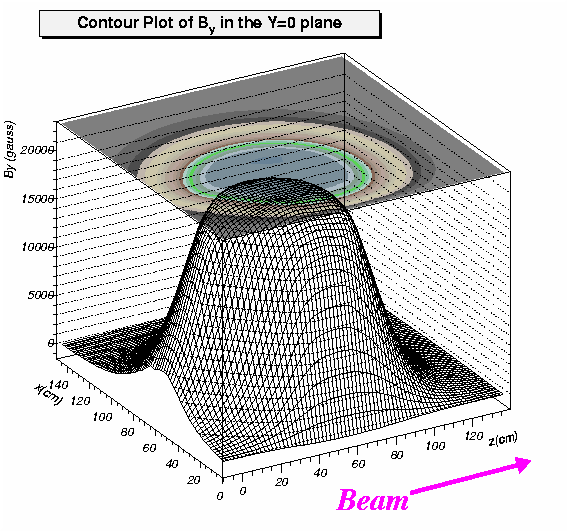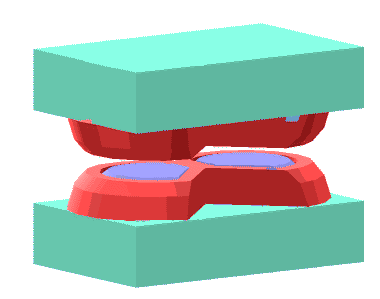
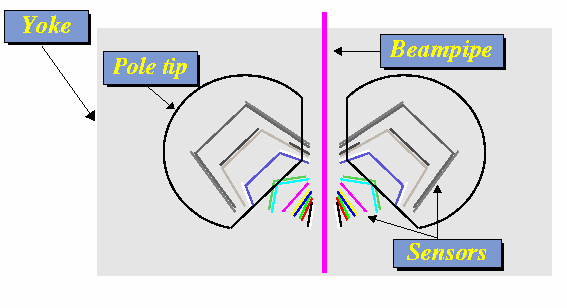
The Phobos magnet consists of two dipole magnets on either side of the beam pipe. The magnet bends charged particles and provides a tool for momentum analysis of these particles. The above sketch of the magnet shows the coils (in red), the pole tips (blue) and the return yoke (green). The silicon detectors that measure the charged particles sit in the gap inbetween the two coils of the dipoles. The picture below shows the arrangement of the 14 planes with the silicon detectors (top view).
The magnetic field was modeled using TOSCA 3D. The next picture shows a contour plot of the magnetic field of one of the dipoles in the center of the gap with the silicon detector planes superimposed on the field.
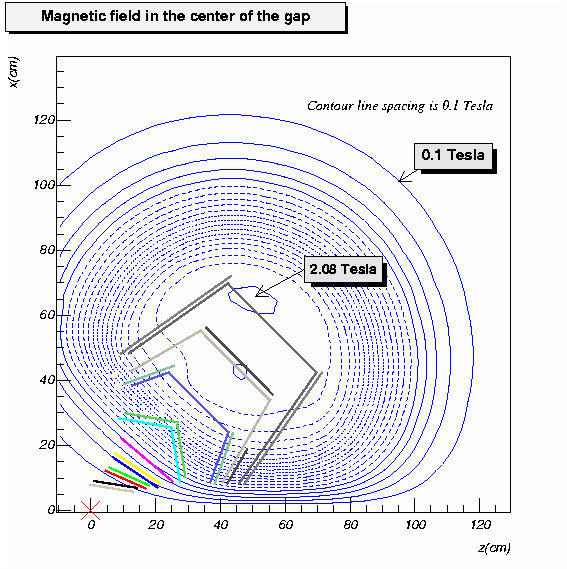
The field increases fairly slowly from the interaction point (the red cross in the picture) to a maximum of about 2 Tesla in the middle of the pole. It is imporant to have a small field initially, so that the charged particles bend little in the first few planes. These planes are used to generate straight line seeds in the track reconstruction software. Once past the first few planes however, it is important to have as large a field as possible, to increases the momentum resolution of the spectrometer. Here (gif or EPS) is another picture of the magnetic field. You can also fly through the 3D magnetic field simulation in VRML.
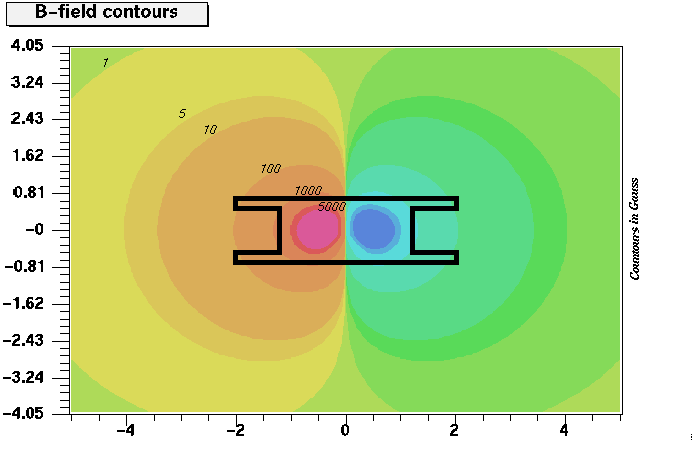
The Stray Field was calculated using Leslie Rosenberg's 2D Magnetic Charge calculation. A program such as TOSCA is not very useful for calculating the far field, because it depends too much on the grid points in the field and the numerics of the field source (the field strength is only good to probably 50 gauss or so). The following picture shows the Stray Field in the tunnel, with the field contours and an outline of the magnet. Note that the X-axis is opposite from the usual Phobos reference frame, Z-Axis is as expected (EPS):
The total magnet is about 194cm high, 404cm long and 140cm wide. It weighs approximately 40.000kg. The maximum field is about 2T and the total power consumption is 342kW.
Last Update: Friday, February 04, 2000 by Patrick Decowski