Cross Talk in Discriminators
Last updated June 23, 2003.
Leading edge discriminator 4413
The time resolution of the victim channel when there are no aggressors is 1.19 counts or 31 ps. 3
Run 12533. Aggressor on channel 1.
The shift due to the crosstalk is 5 counts = 125 ps.
Run 12534. Aggressor on channel 2.
Run 12355. Aggressor on channel 3.
Run 12536. Aggressor on channel 4.
Run 12530. Effect of 3m of SpectraStrip
Crosstalk = 10 counts. Twice bigger than with separate wires.
Run 12532. Aggressor on channel 3.
Summary for the discriminator LeCroy 4413.
Leading edge discriminator 3412
The resolution (RMS) is 1.26 counts. Similar to disc 4413.
Run 12539. Aggressor on channel 1.
Run 12540. Aggressor on channel 2.
Run 12541. Aggressor on channel 3.
Run 12543. Aggressor on channel 4.
Run 12544. Victim – channel 7, aggressor - channel 6
Effect is the same as for channel 0 and 1.
Run 12545. Amplitude of the aggressor increased 10 times.
The crosstalk does not depend on the amplitude of the aggressor.
Is the cross talk inside the discriminator or inside the
TDC?
Run 12558. No crosstalk in the discriminator 3412
The crosstalk, which is seen in run 12539, is all originated inside the TDC!
Run 12559. The discriminator 4413 generates crosstalk.
The crosstalk, which is seen in run 12533, is mostly originated inside the discriminator 4413!
Run 12579. Reference. Discriminator 3412
Run 12576. Reference. Discriminator Philips 7106
The discriminator Philips 7106 has the same crosstalk, as discriminator 4413!
Setup
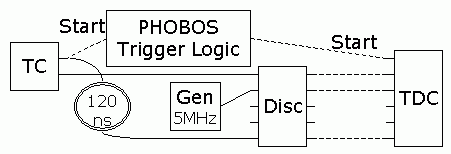
Leading edge discriminator 4413
The threshold is 30 mV.
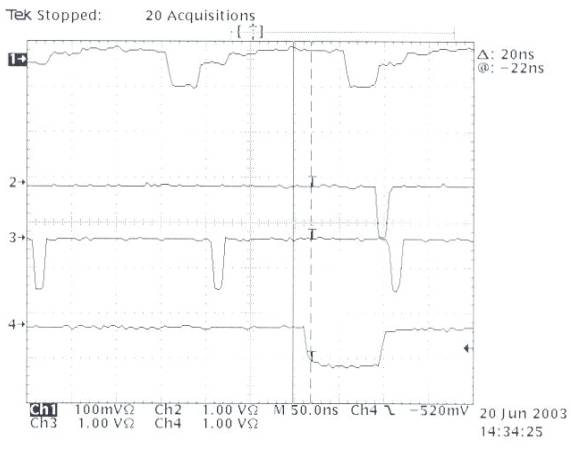
1 – aggressor at the input of the discriminator
2 – victim
3 – aggressor at the output of the discriminator
4 – TDC Gate
Run 12529. Clean conditions.
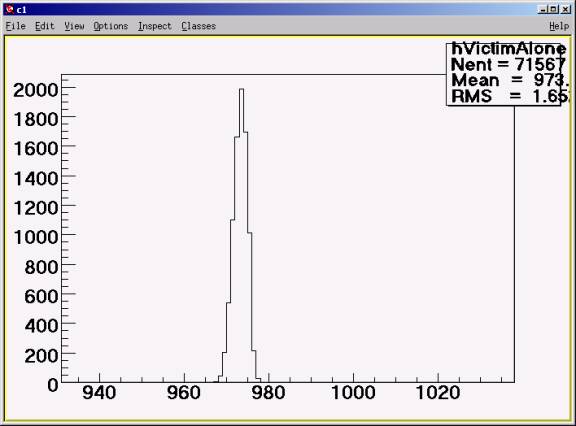
chain.Draw("TDC17[16]>>hVictimAlone")
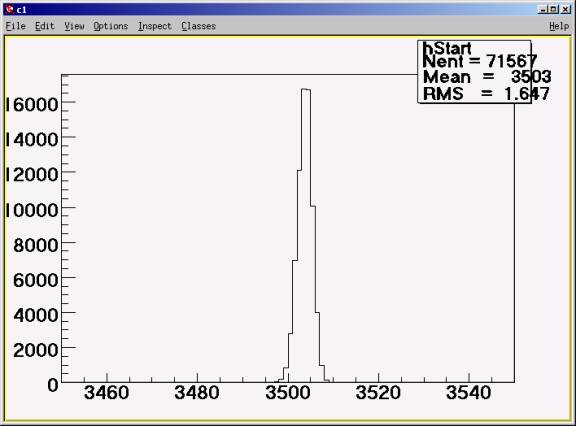
chain.Draw("TDC17[31]>>hStart")
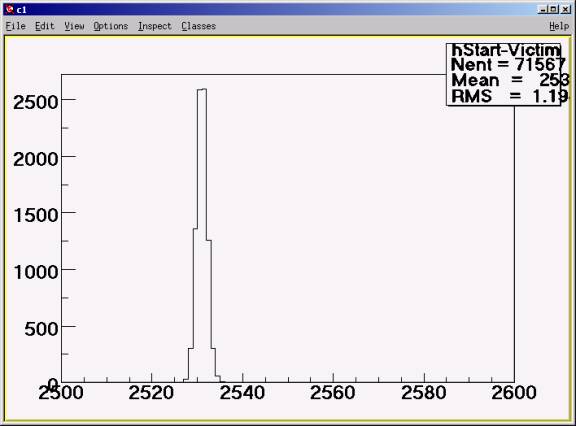
chain.Draw("(TDC17[31]-TDC17[16])>>hStart-Victim")
The time resolution of the victim channel when there are no aggressors is 1.19 counts or 31 ps.
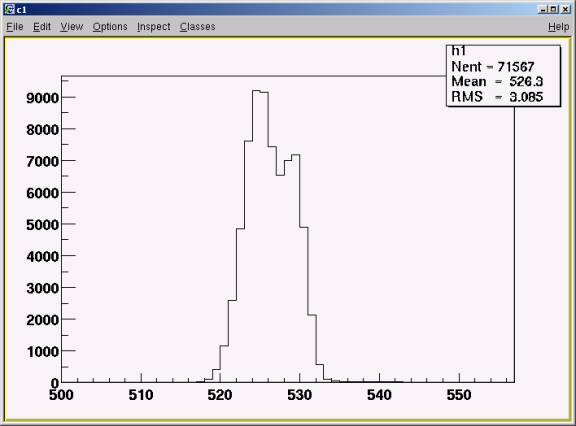
Draw("(TDC13[60])>>h1
The resolution of the L0 is wider than Start
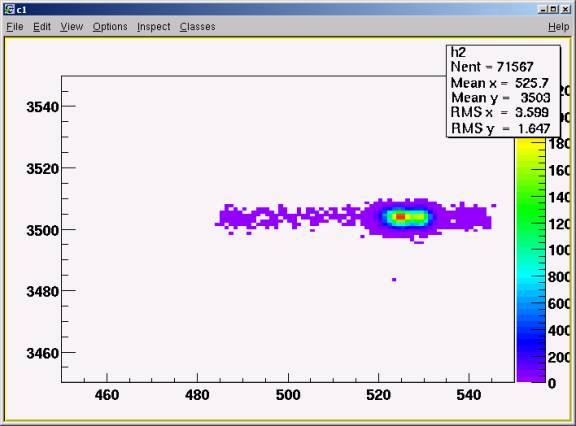
Draw("TDC17[31]:TDC13[60]>>h2
And it is not correlated with the Start.
The L0 at TDC13.60 has wide RMS=3.1 but Start at TDC17.31 has RMS=1.6. That means that L0 which goes to the start of the TDC is OK, but L0 which goes to TDC13.60 is bad.
Run 12533. Aggressor on channel 1.
Victim: disc.0 ->wire-> TDC17[16]
Aggressor: disc.1 ->wire-> TDC17[17]
Start: disc.15 ->wire-> TDC17[31]
Checking the resolution
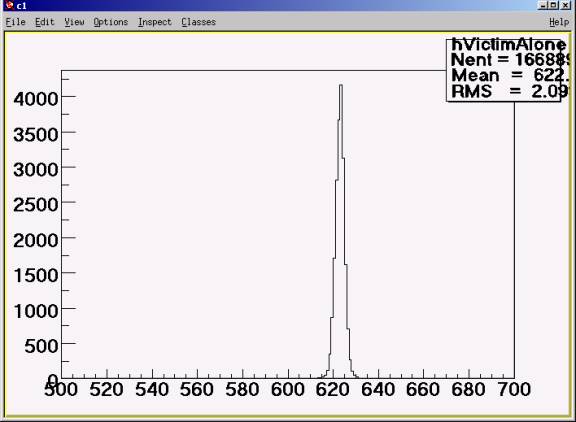
chain.Draw("TDC17[16]>>hVictimAlone")
Why it is shifted left by 350? Because in the run 12529
it was 3m of SpectraStrip instead of seprate wires.
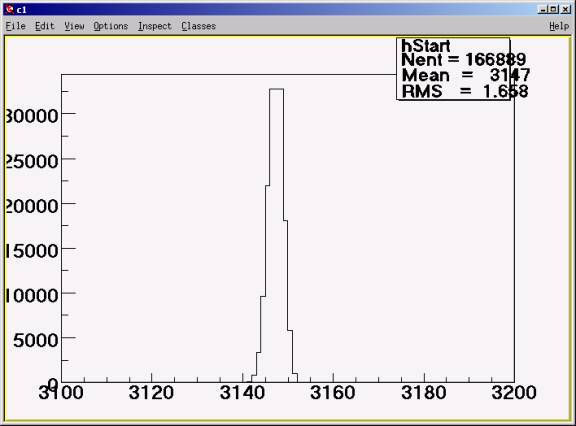
chain.Draw("TDC17[31]>>hStart")
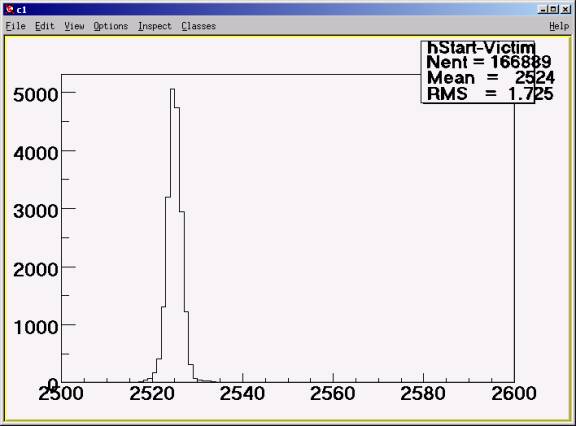
chain.Draw("(TDC17[31]-TDC17[16])>>hStart-Victim")
Good, the difference did not move
Effect of the aggressor
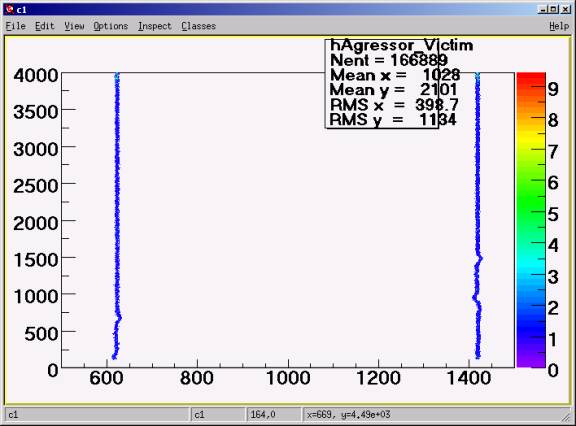
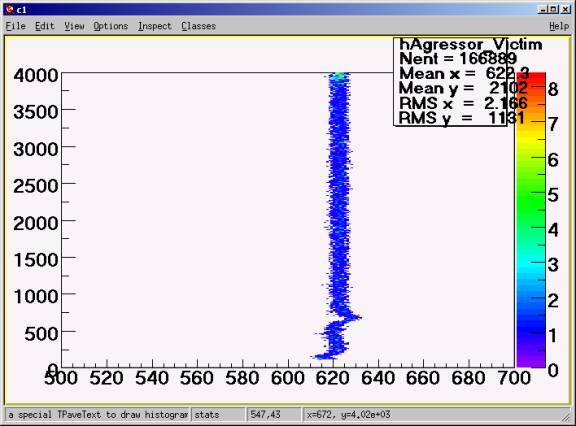
Draw("TDC17[17]:TDC17[16]>>hAgressor_Victim","","colz")
The shift due to the crosstalk is 5 counts = 125 ps.
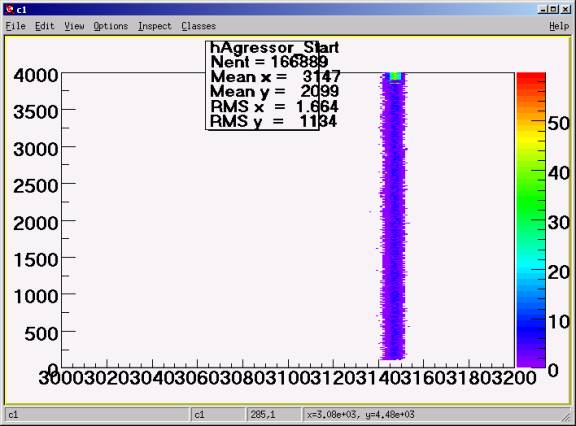
Draw("TDC17[17]:TDC17[31]>>hAgressor_Start","","colz")
Run 12534. Aggressor on channel 2.
Victim: disc.0 ->wire-> TDC17[16]
Aggressor: disc.2 ->wire-> TDC17[18]
Start: disc.15 ->wire-> TDC17[31]
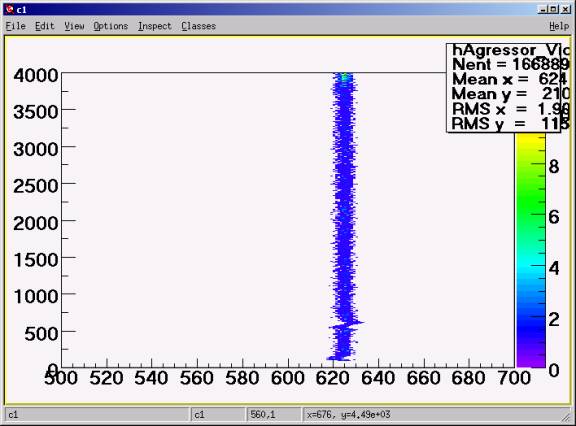
Draw("TDC17[18]:TDC17[16]>>hAgressor_Victim","","colz")
The crosstalk = 3 counts
Run 12355. Aggressor on channel 3.
Victim: disc.0 ->wire-> TDC17[16]
Aggressor: disc.3 ->wire-> TDC17[19]
Start: disc.15 ->wire-> TDC17[31]
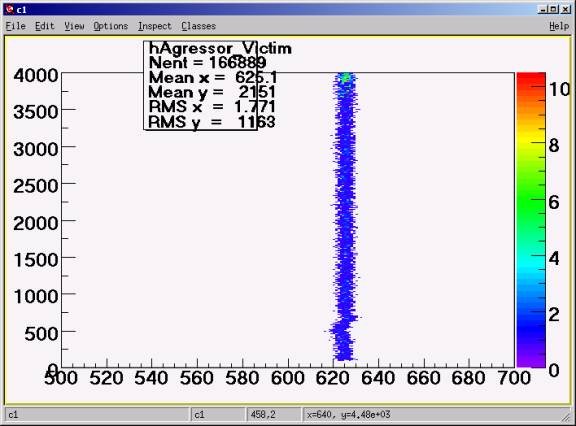
Draw("TDC17[19]:TDC17[16]>>hAgressor_Victim","","colz")
The crosstalk = 2 counts
Run 12536. Aggressor on channel 4.
Victim: disc.0 ->wire-> TDC17[16]
Aggressor: disc.4 ->wire-> TDC17[20]
Start: disc.15 ->wire-> TDC17[31]
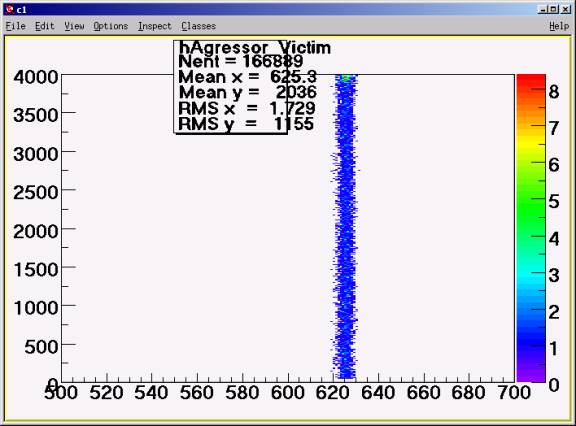
Draw("TDC17[20]:TDC17[16]>>hAgressor_Victim","","colz")
No crosstalk.
Run 12530. Effect of 3m of SpectraStrip
Aggressor on channel 1.
Victim: disc.0 ->wire-> TDC17[16]
Aggressor: disc.1 ->wire-> TDC17[17]
Start: disc.15 ->wire-> TDC17[31]
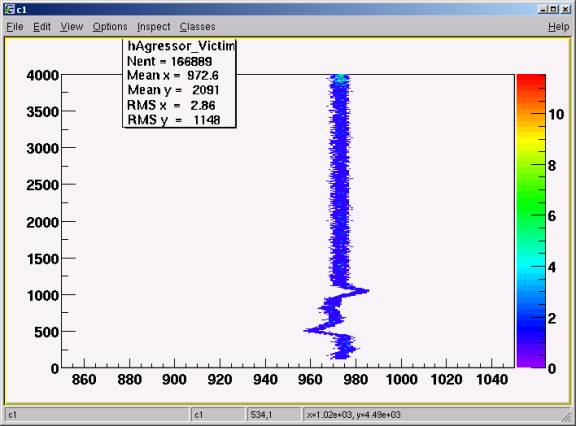
Draw("TDC17[17]:TDC17[16]>>hAgressor_Victim","","colz")
Shift 10 counts. Compare with run 12533
Crosstalk = 10 counts. Twice bigger than with separate wires.
Run 12532. Aggressor on channel 3.
Victim: disc.0 ->wire-> TDC17[16]
Aggressor: disc.3 ->wire-> TDC17[19]
Start: disc.15 ->wire-> TDC17[31]
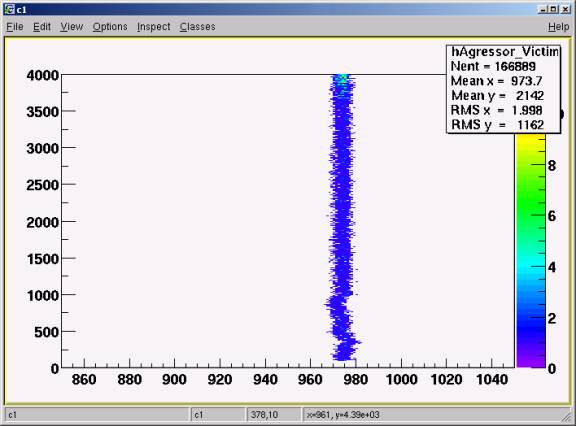
Draw("TDC17[19]:TDC17[16]>>hAgressor_Victim","","colz")
Compare with run 12535. Almost the same.
Summary for the discriminator LeCroy 4413.
- In clean conditions (no aggressors) the RMS of the
single channel is 41.0 ps. The RMS of the channel relative to the delayed
start is slightly better = 30 ps.
- The time shift of the channel 0, when the front or
tail of the aggressor applied to the channel 1, is 125 ps.
- The effect of the crosstalk is gradually decreasing
with distance, disappearing on the fourth neighbor. E.g. the crosstalk
from channel 2 is 75 ps, from channel 3 is 50 ps, and is negligible from
channel 4.
Leading edge discriminator 3412
Threshold setting: 25 mV.
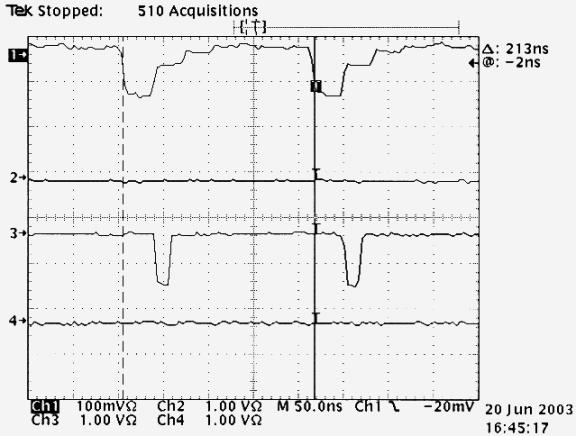
Ch 1. disc input
Ch 3. disc output
Run 12538. Clean conditions
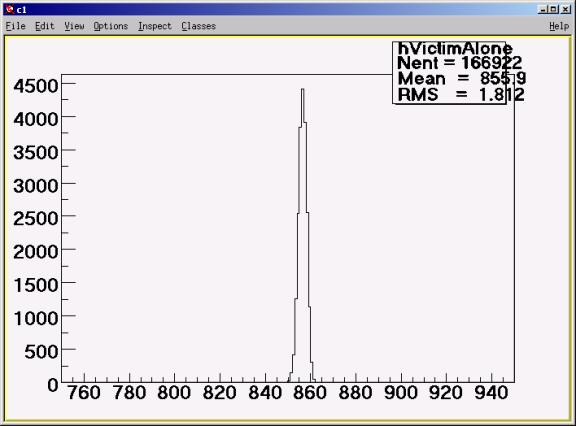
chain.Draw("TDC17[16]>>hVictimAlone")
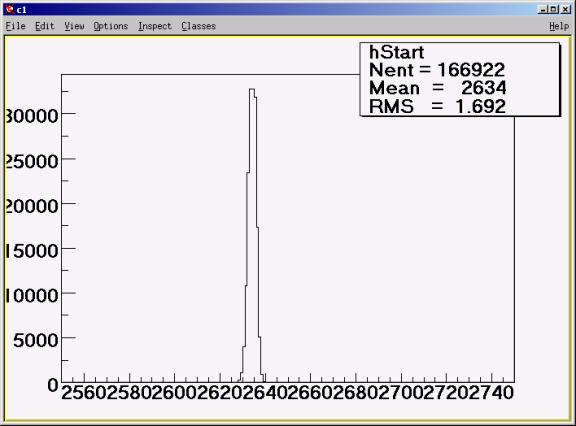
Draw("TDC17[31]>>hStart")
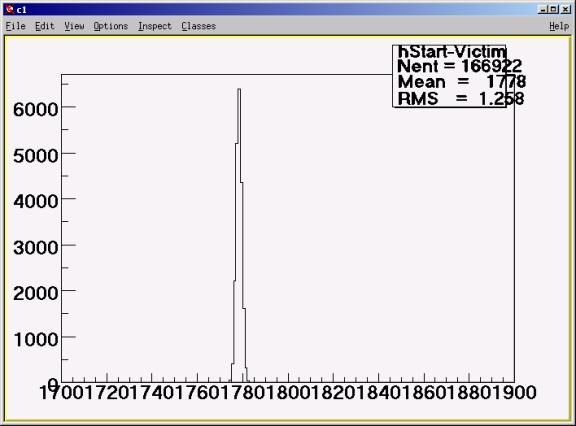
Draw("(TDC17[31]-TDC17[16])>>hStart-Victim")
The resolution (RMS) is 1.26 counts. Similar to disc 4413.
Run 12539. Aggressor on channel 1.
Victim: disc.0 ->wire-> TDC17[16]
Aggressor: disc.1 ->wire-> TDC17[17]
Start: disc.15 ->wire-> TDC17[31]
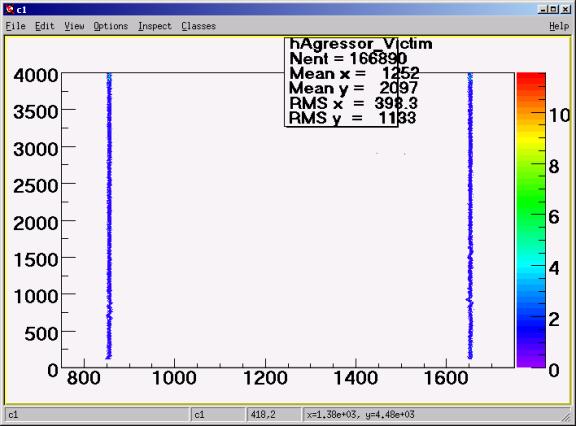
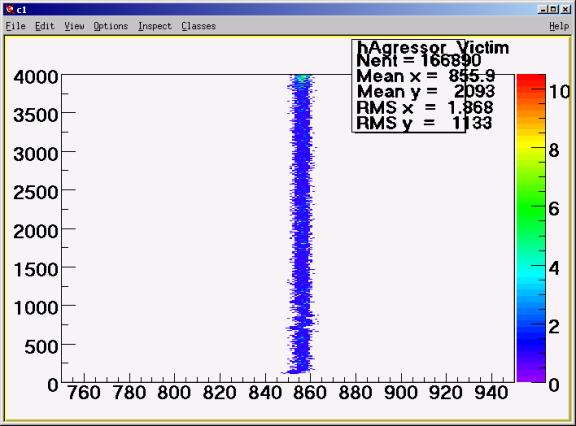
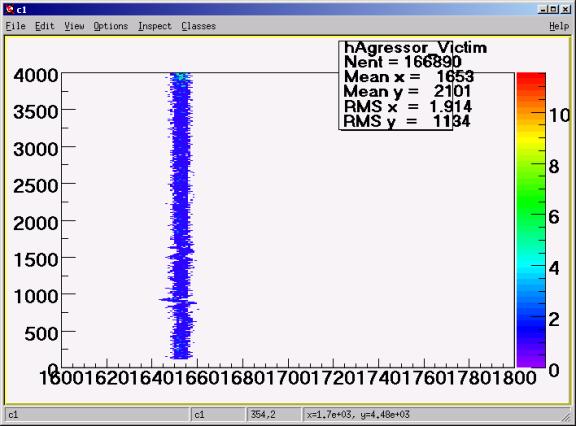
Shift 5 counts. It is basically the same by amplitude but trouble zone is much narrow than in disc. 4413
It is shown below in run 12558 that all this crosstalk is originated inside the TDC.
Run 12540. Aggressor on channel 2.
Victim: disc.0 ->wire-> TDC17[16]
Aggressor: disc.2 ->wire-> TDC17[18]
Start: disc.15 ->wire-> TDC17[31]
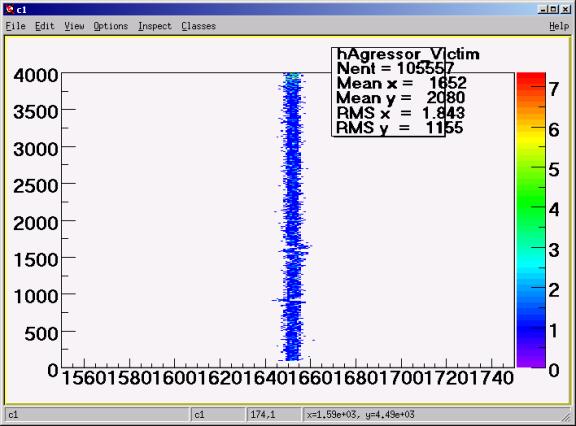
Shift 5 counts
Run 12541. Aggressor on channel 3.
Victim: disc.0 ->wire-> TDC17[16]
Aggressor: disc.3 ->wire-> TDC17[19]
Start: disc.15 ->wire-> TDC17[31]
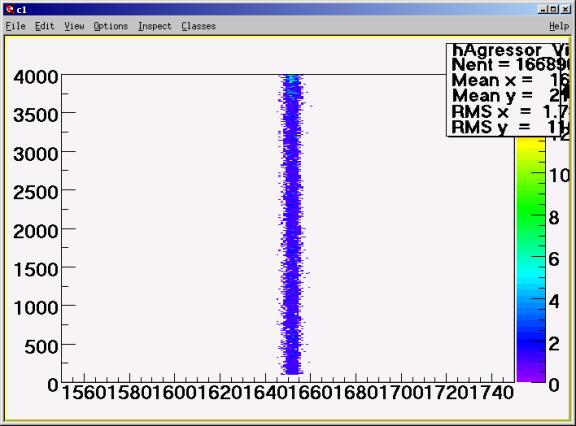
Draw("TDC17[19]:TDC17[16]>>hAgressor_Victim","","colz")
No crosstalk from channel 3.
Run 12543. Aggressor on channel 4.
Victim: disc.0 ->wire-> TDC17[16]
Aggressor: disc.4 ->wire-> TDC17[20]
Start: disc.15 ->wire-> TDC17[31]
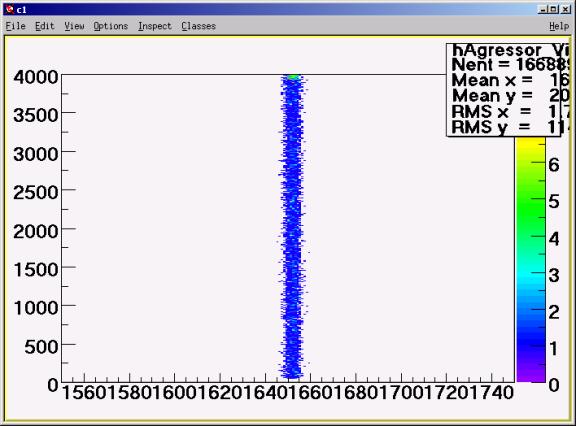
Draw("TDC17[20]:TDC17[16]>>hAgressor_Victim","","colz")
No crosstalk from channel 4.
Run 12544. Victim – channel 7, aggressor - channel 6
Victim: disc.7 ->wire-> TDC17[23]
Aggressor: disc.6 ->wire-> TDC17[22]
Start: disc.15 ->wire-> TDC17[31]
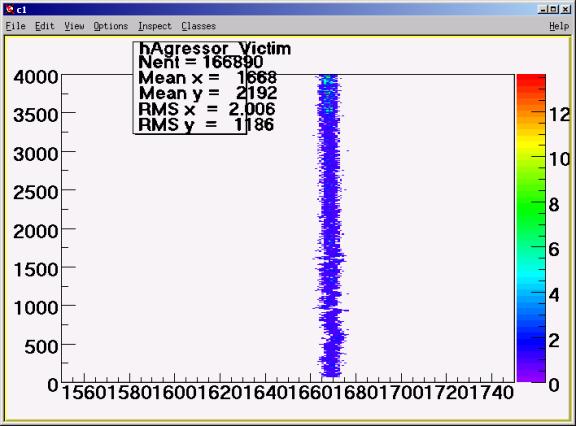
Draw("TDC17[22]:TDC17[23]>>hAgressor_Victim","","colz")
Effect is the same as for channel 0 and 1.
Run 12545. Amplitude of the aggressor increased 10 times.
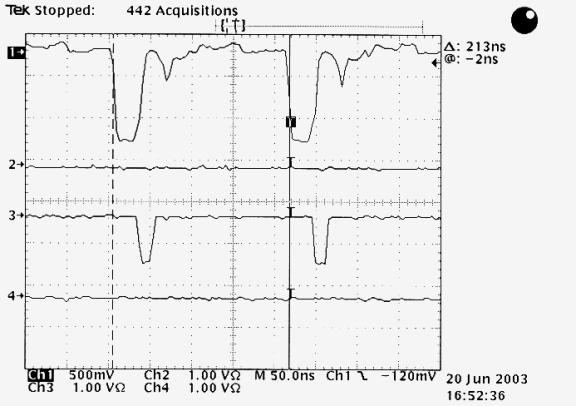
Ch 1. disc input
Ch 3. disc output
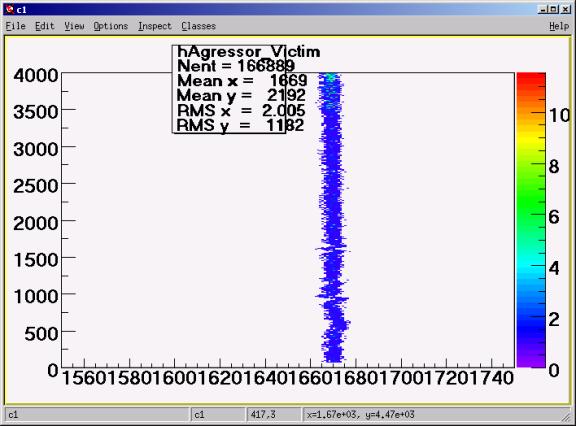
The amplitude of the aggressor at the input of the disc have changed from 0.1 to 1.0 V
The crosstalk does not depend on the amplitude of the aggressor.
Is the cross talk inside the discriminator or inside the TDC?
Run 12558. No crosstalk in the discriminator 3412
Victim: disc.0 ->wire-> TDC17[16]
Aggressor: disc.1 ->wire-> TDC17[20]
Start: disc.15 ->wire-> TDC17[31]
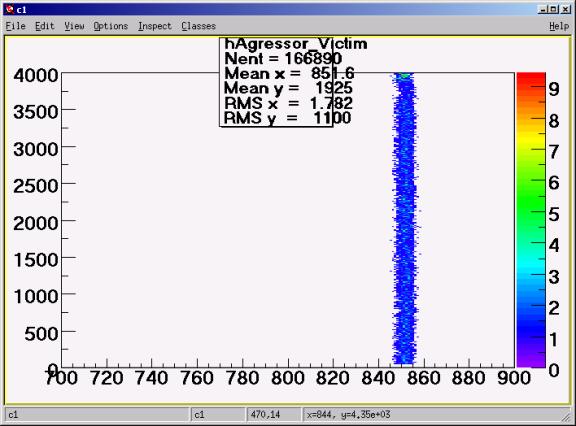
Draw("TDC17[21]:TDC17[20]
Compare this with run 12539 and 12543.
The crosstalk, which is seen in run 12539, is all originated inside the TDC!
Run 12559. The discriminator 4413 generates crosstalk.
Victim: disc.0 ->wire-> TDC17[16]
Aggressor: disc.1 ->wire-> TDC17[20]
Start: disc.15 ->wire-> TDC17[31]
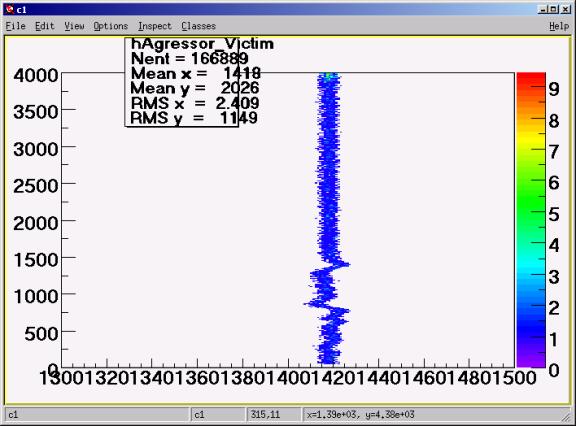
Draw("TDC17[20]:TDC17[16]
This is the same as run 12533.
Crosstalk = 5.
The crosstalk, which is seen in run 12533, is mostly originated inside the discriminator 4413!
Run 12579. Reference. Discriminator 3412
7/3/2003
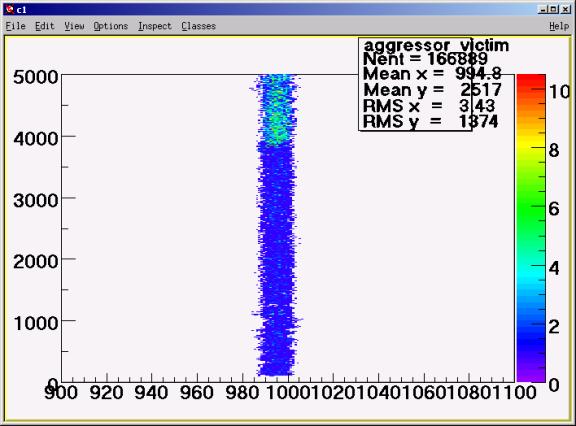
Draw("TDC17[17]:TDC17[16]
Note the RMS X is about 2
Run 12576. Reference. Discriminator Philips 7106
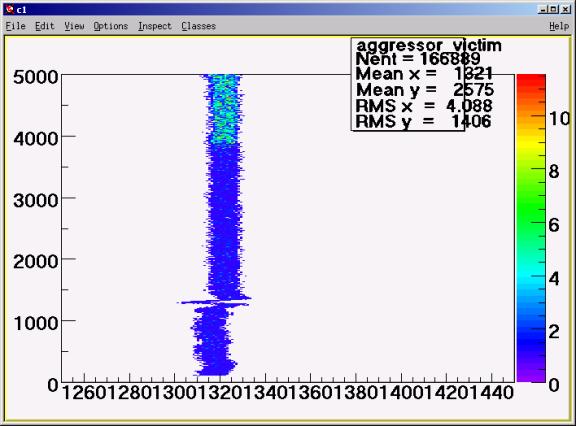
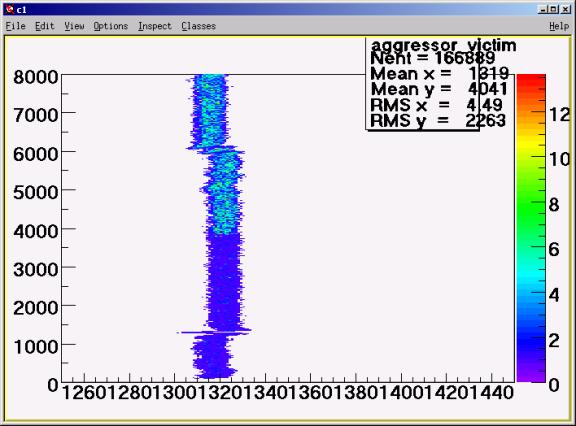
Draw("TDC17[17]:TDC17[16]
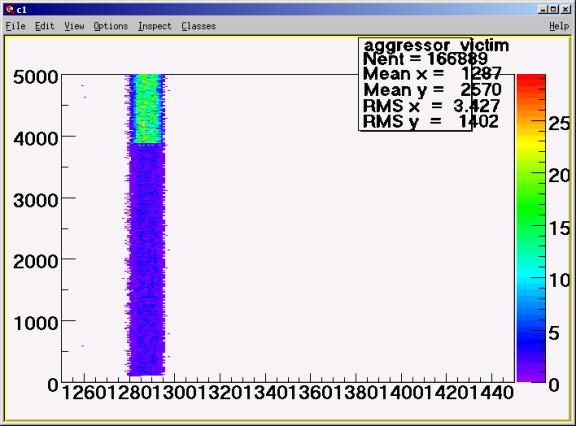
Draw("TDC17[17]:TDC17[31]
The discriminator Philips 7106 has the same crosstalk, as discriminator 4413!
Summary
- The discriminator LeCroy 3412 has no crosstalk between channels (see
run 12558).
- The
discriminator LeCroy 4413 has significant crosstalk ~125 ps (see run 12559)!
- The TDC 1875A has ‘acceptable’ crosstalk (amplitude
~100 ps, very narrow trouble zone). The crosstalk disappears
when distance between channels is more than 2 neighbors.
- The crosstalk does not depend on the amplitude of
the input signal.
- Using
3m of SpectraStrip results in doubling the crosstalk. E.g. the crosstalk
from the neighboring channel, when disc. 4413 is connected to TDC via 3m
of SpectraStrip is 250 ps. The crosstalk is 125 ps when using the separate
wires. Actually, (see study 6/23/03) the 3m of SpectraStrip completely
masks out the internal crosstalk of the discriminators.